
Being served with what most people call a “restraining order” raises immediate, practical questions about whether you can go back to your house, contact the other person to talk about kids or other logistics, and what happens if you violate one of the rules.
A temporary restraining order (TRO) is a temporary civil order that may be used in family-law and other civil cases to preserve property or regulate conduct while a case is pending. A protective order, on the other hand, can be different. It may be issued in cases involving allegations of family violence, stalking, sexual assault, trafficking, or other qualifying conduct and can impose restrictions on contact, firearms, and where a person may go.
What Does Someone Have to Show to Get a Protective Order in Texas?

For a family-violence protective order, the applicant must allege facts that satisfy Texas law’s definition of domestic violence. That can include physical harm, assault, sexual assault, or threats of imminent physical harm involving people in certain family, household, or dating relationships.
Texas law covers relationships such as current or former spouses, dating partners, relatives, people who live or previously lived together, and people who have a child together.
Texas also permits protective orders in some cases involving stalking, sexual assault, trafficking, and certain other offenses, even when no family or dating relationship exists. In those cases, the legal requirements depend on the conduct alleged rather than a family or household relationship.
Does the Person Asking for the Order Have to Prove Their Allegations?
For a final family-violence protective order, the court holds a hearing and determines whether the statutory requirements have been met. An application describing the alleged conduct and the protections being requested is filed. The respondent is generally served with notice and has an opportunity to appear and respond.
The applicant may rely on testimony, photographs, medical records, text messages, witnesses, or other admissible evidence. After considering the evidence, the judge decides whether the legal grounds for issuing a final protective order have been established.
Texas law also permits temporary ex parte protective orders in certain circumstances. Those orders may be entered before a full hearing when the statutory requirements are satisfied.
What Can a Texas Protective Order Prohibit You From Doing?
The exact restrictions depend on the language of the specific order.
A Texas protective order may prohibit a person from:
- Committing or threatening family violence
- Contacting the protected person when the order specifically prohibits direct contact
- Communicating in a threatening or harassing manner
- Sending prohibited threats or communications through another person
- Going to or near locations identified in the order, such as a residence, workplace, school, or child-care facility
- Following, tracking, or monitoring the protected person, including through certain GPS devices or monitoring applications
- Possessing firearms or ammunition when prohibited by the order and applicable law
The language of the order controls what a person is required or prohibited from doing. Anyone served with an order should read its terms carefully because restrictions can vary from one case to another.
Can a Protective Order Force You to Leave Your Home?
Potentially, yes. Texas law allows courts to grant one person exclusive possession of a qualifying residence and, in certain circumstances, order another person to leave. These rules can apply even when both parties have some ownership, lease, or occupancy interest in the property, although the court must satisfy the applicable statutory requirements.
Temporary ex parte removal from a residence has additional requirements. Among other things, the court generally must make specific findings related to recent family violence and a clear and present danger before excluding someone from a residence without prior notice.
This can be especially disruptive when the parties previously lived together. Someone subject to an order may suddenly need another place to stay or may be unable to retrieve clothes, medication, tools, or work equipment without making arrangements first.
If personal belongings remain at the residence, it is important to follow the terms of the order rather than simply returning to the property. A lawyer can explain what options may be available for arranging retrieval without violating the court’s restrictions.
What Happens If You Violate a Protective Order in Texas?
Certain knowing or intentional violations of qualifying protective orders or bond conditions can lead to a separate criminal charge under Texas law.
A violation is generally prosecuted as a Class A misdemeanor. A Class A misdemeanor conviction can result in up to one year in county jail, a fine of up to $4,000, or both.
In some circumstances, the offense can become a third-degree felony. For example, Texas law provides felony treatment when a person has two or more qualifying prior convictions or violates an order by committing assault. A third-degree felony carries two to 10 years in prison and a fine of up to $10,000.
The required mental state matters. A technical or accidental breach does not automatically establish criminal liability under the protective-order violation statute. Whether conduct amounts to a criminal violation depends on the order, the conduct at issue, and the facts surrounding it.
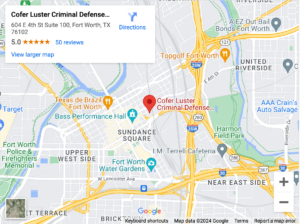
Call Cofer Luster Criminal Defense Lawyers for a Confidential Consultation With a Fort Worth Family Violence Lawyer Today
A protective order can affect where you live, whom you may contact, whether you can possess firearms, and how related criminal or family-law proceedings develop. Certain knowing or intentional violations can also result in a separate criminal case carrying jail time or felony exposure.
Cofer Luster Criminal Defense Lawyers can review the allegations and the terms of the order, explain the court process, and evaluate potential defenses if you are accused of a violation. Contact us today at (682) 777-3336 to schedule a confidential consultation with a Fort Worth family violence attorney.